Upper West Side Architecture Tour

Explore New York’s architecture and urban life through architect-led walking tours and experiences.

Tour Overview

The Upper West Side Architecture Tour explores one of New York's most distinctive neighborhoods, where residential architecture, cultural institutions, and public space combine to create a uniquely urban environment.  On this architect-led walking tour, we explore how urban planning, cultural ambition, transportation, and residential development transformed the western edge of Manhattan into a center of architectural innovation, artistic life, and urban sophistication.

The tour traces the neighborhood’s evolution from the creation of Central Park and the rise of luxury apartment living to the contemporary transformation of Columbus Circle and Lincoln Center. Along Central Park West, participants encounter some of New York’s most celebrated residential architecture, from early luxury apartment houses such as The Dakota and The San Remo to Art Deco landmarks by Emery Roth and Irwin Chanin. 

The tour also explores the relationship between architecture, landscape, and public life through Central Park, Broadway, and the district’s major cultural institutions, including the American Museum of Natural History and Lincoln Center for the Performing Arts.

Choose Your Experience

Choose the experience format that best fits your interests, schedule, and group size.

Public Tour

Small groups up to 10 guests
Duration: 2 hours
Language: English
Adults $59, Youth $39

Private Tour

Flexible Size and Scheduling
Duration: 2 / 4 / 6 hours
In English, Spanish, Italian & French
Starting at $399

Group Program

Customized itineraries and themes
From 2 hours to multiple days
In English, Spanish, Italian & French
Price by request

Tour Highlights

Central Park (Frederick Law Olmsted and Calvert Vaux, 1858)
A pioneering work of landscape architecture that transformed urban life and shaped the development of the Upper West Side as one of New York’s most prestigious residential districts.

American Museum of Natural History (multiple phases, 1870s–2024)
One of New York’s most important civic and scientific institutions, continuously expanded through more than a century of architectural innovation and public education.

The Dakota Apartments (Henry J. Hardenbergh, 1880–1884)
One of New York’s earliest luxury apartment buildings, redefining urban residential life through monumental design and picturesque massing overlooking Central Park.

San Remo Apartments (Emery Roth, 1929–1930)
An iconic twin-towered residential landmark representing the elegance and skyline identity of prewar Upper West Side architecture.

Lincoln Center for the Performing Arts (original campus 1950s–1960s; ongoing transformations)
One of the world’s most influential cultural complexes, where modern architecture, performance, and urban renewal reshaped the civic identity of New York.

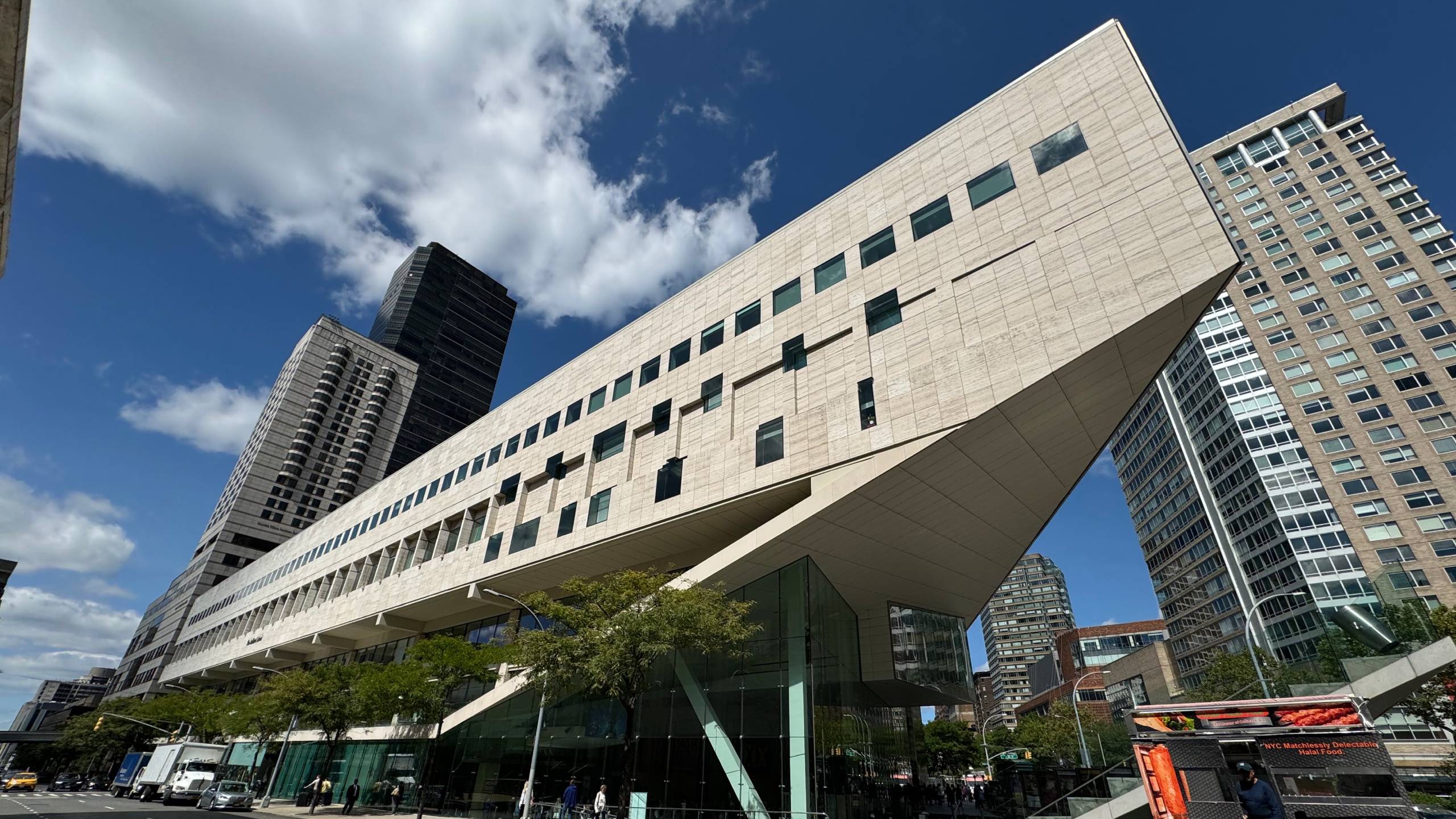
Alice Tully Hall (Pietro Belluschi, 1969; renovation by Diller Scofidio + Renfro, 2011)
A landmark transformation of modernist architecture into a transparent and contemporary cultural space engaging the life of the city.

View Full List of Buildings and Sites on this Tour

A curated selection of landmark apartment buildings, cultural institutions, churches, museums, public spaces, and contemporary developments tracing the architectural evolution of the Upper West Side from the late 19th century to contemporary New York.

Historic Monuments, Civic Landmarks, and Early Urban Development
Columbus Circle Monument (Gaetano Russo, 1892)
Holy Trinity Lutheran Church (Schickel & Ditmars, 1903)
Congregation Shearith Israel (Brunner & Tryon, 1896–1897)
Universalist Church of New York and Parish House (William A. Potter, 1897–1898)

Residential Architecture and Central Park West Urbanism
The Dakota Apartments (Henry J. Hardenbergh, 1880–1884)
The Brentmore (Schwartz & Gross, 1909–1910)
The Langham (Clinton & Russell, 1904–1907)
The Kenilworth (Townsend, Steinle & Haskell, 1906–1908)
Hotel des Artistes (George Mort Pollard, 1915–1918)
70 Central Park West (Rich & Mathesius, 1916–1919)
55 Central Park West (Schwartz & Gross, 1929–1930)
The Oliver Cromwell (Emery Roth, 1927)
The Beresford (Emery Roth, 1929)
San Remo Apartments (Emery Roth, 1929–1930)
Century Apartments (Irwin Chanin, 1931)
Majestic Apartments (Irwin Chanin with Jacques Delamarre, 1930–1931)
15 Central Park West (Robert A.M. Stern Architects, 2008)

Modern and Contemporary Architecture around Columbus Circle
Deutsche Bank Center / Time Warner Center (David Childs, SOM, 2004)
Museum of Arts and Design (Allied Works Architecture, 2008)
Hearst Tower (Foster + Partners, 2006)
Trump International Hotel & Tower (Philip Johnson & Costas Kondylis, 1997)
The Park Loggia (Skidmore, Owings & Merrill, 2019)
Sofia Apartments / Kent Automatic Parking Garage (Jardine, Hill & Murdock, 1929–1930)
Snøhetta Residential Tower, 65th–66th Street (Snøhetta, anticipated 2026)

Lincoln Center and Cultural Modernism
Lincoln Center for the Performing Arts (master plan and original campus, 1950s–1960s)
Metropolitan Opera House (Wallace Harrison, 1966)
David Geffen Hall / former Philharmonic Hall (Max Abramovitz, 1962; renovation by Diamond Schmitt, 2022)
David H. Koch Theater / New York State Theater (Philip Johnson, 1964)
Vivian Beaumont Theater (Eero Saarinen, 1965)
New York Public Library for the Performing Arts (Gordon Bunshaft, 1965)
Alice Tully Hall (Pietro Belluschi, 1969; renovation by Diller Scofidio + Renfro, 2011)
Fordham University School of Law (Pei Cobb Freed & Partners, 2014)
San Juan Hill Neighborhood (demolished mid-20th century)

Museums, Science, and Civic Architecture
New-York Historical Society (York & Sawyer, 1903–1908; expansion by Walker & Gillette, 1937–1938)
American Museum of Natural History (multiple phases, 1870s–2024)
General Plan and First Wing (Calvert Vaux & J. Wrey Mould, 1872–1877)
West 77th Street Frontage and Auditorium (J. C. Cady & Co., 1888–1908)
Southwest Wing (Charles Volz, 1905–1908)
Theodore Roosevelt Memorial (John Russell Pope, 1931–1934)
Museum Library (Kevin Roche John Dinkeloo & Associates, 1990–1992)
Rose Center for Earth and Space / Hayden Planetarium (Polshek Partnership, 2000)
Richard Gilder Center for Science, Education, and Innovation (Studio Gang, 2024)

Itinerary

Meeting Point: Columbus Circle

This architect-led walking tour explores the Upper West Side through a curated sequence of cultural institutions, luxury apartment buildings, public spaces, and landmark urban developments, tracing the transformation of the neighborhood from a late 19th-century residential district into one of New York’s most influential centers of architecture, culture, and urban life.

Columbus Circle and the Gateway to the Upper West Side
We begin at Columbus Circle, where transportation infrastructure, public space, luxury development, and contemporary architecture converge. We examine how projects such as Deutsche Bank Center, the Museum of Arts and Design, and nearby residential towers transformed the southern edge of the neighborhood.

Lincoln Center and San Juan Hill: Urban Renewal and Cultural Modernism
Moving north through Lincoln Center, we explore one of the most ambitious cultural and urban redevelopment projects of the 20th century. We visit landmarks such as the Metropolitan Opera House, David Geffen Hall, Alice Tully Hall, the New York Public Library for the Performing Arts, and the Vivian Beaumont Theater. We also reflect on the history of San Juan Hill, the vibrant Black and Puerto Rican neighborhood displaced during the creation of Lincoln Center, revealing the social and political dimensions of postwar redevelopment in New York City.

Central Park West: Residential Prestige and the Evolution of Urban Living
Continuing north along Central Park West, we encounter one of the world’s most celebrated collections of residential architecture. Buildings such as the Dakota, the Langham, the Brentmore, the Majestic, the San Remo, and the Century Apartments trace the evolution of urban living from early luxury apartment houses to the grand residential towers of the early 20th century.

The American Museum of Natural History: Architecture, Science, and Civic Identity
The final section of the tour explores the extraordinary architectural evolution of the American Museum of Natural History over more than 150 years of expansion. From the Theodore Roosevelt Memorial to the Hayden Planetarium and the contemporary Gilder Center, the museum complex demonstrates how architecture continues to evolve alongside scientific discovery, public education, and contemporary design innovation.

Today, the Upper West Side remains one of New York’s most enduring expressions of residential elegance, cultural ambition, and urban sophistication — where architecture, landscape, and culture continue to shape urban life in New York.

Ending Point: American Museum of Natural History

Key Themes

Central Park and Urban Transformation
Explore how Central Park reshaped the western edge of Manhattan and established the Upper West Side as one of New York’s most desirable residential districts.

Luxury Apartment Living
Trace the evolution of urban residential life from 19th-century townhouses and early apartment buildings to the grand apartment houses of Central Park West.

Lincoln Center and the Urban Renewal of the 1960s
Discover how Lincoln Center transformed the cultural identity of New York while revealing the ambitions and social consequences of postwar urban renewal.

Architecture, Culture, and Civic Identity
Explore how museums, performance venues, churches, and public institutions continuously evolve and help shape neighborhood identity.

Contemporary Architecture and Urbanism
Explore how projects such as Hearst Tower, Alice Tully Hall, and 15 Central Park West reinterpret the architectural traditions of the Upper West Side through contemporary design.

Meet Your Architect Guides

Our tours are led by architects and urban experts with deep knowledge of New York’s architecture, development, and city systems.

Each guide brings a unique perspective, combining professional experience with a passion for sharing the stories behind the city’s buildings and neighborhoods.

Tour Gallery

A glimpse into the architecture, streets, and spaces explored on this tour.

Practical Information

Accessibility

This tour involves moderate walking at a comfortable pace with regular stops. Some areas may include uneven surfaces. Please contact us in advance for specific accessibility needs.

What to Bring

Comfortable walking shoes and weather-appropriate clothing are recommended. In warmer months, bring water and sun protection. In cooler weather, dress in layers.

Weather Policy

Tours run rain or shine. In severe weather, we will contact you in advance to reschedule or provide alternatives.

Cancellation Policy

Public tours may be canceled or rescheduled up to 24 hours in advance for a full refund.

Private tours and group programs follow specific terms provided at booking.

Testimonials

Our group had a wonderful tour of the Upper West Side with Ivan! A few of us have lived on the UWS/NYC for years, but still learned so many new things about this neighborhood. Ivan was incredibly knowledgeable and passionate about the tour he put together. Cannot recommend it enough, and looking forward to getting another one on the books soon.

Rebecca G.

A fascinating tour with an excellent guide. I'm an architect and had a million questions, all of which were answered. There were also people in the group who weren’t architects, and the tour was just as enjoyable for them. Ivan is very knowledgeable and pleasant. I will definitely recommend!

Sharon

Frequently Asked Questions


Is this tour suitable if I don’t have an architecture background?

Yes. Our tours are designed to be engaging and accessible to all visitors, whether you are an architecture enthusiast, a professional, or simply curious about the city.

Who is this tour designed for?

This tour is designed for architecture enthusiasts, cultural travelers, professionals, students, and curious New Yorkers interested in the intersection of architecture, urbanism, history, and city life.

How much walking is involved?

This is a walking tour covering approximately 1.5 miles. A moderate level of walking is required, with regular stops along the route.

Can this tour be customized?

Yes. Private tours and group programs can be tailored to your interests, schedule, and areas of focus.

   Still have some questions?

  Our team is happy to help you choose the right experience.

Discover New York Through Architecture

Join a public tour or plan a private experience tailored to your interests.

Explore More Architecture Tours in New York

Build Tours offers architecture tours across New York City’s most distinctive neighborhoods. Each experience is led by architects and urban experts who reveal the buildings, public spaces, and stories that shaped the city.