This architect-led walking tour explores Lower Manhattan through a curated sequence of landmark interiors, revealing how architecture shaped civic institutions, financial centers, corporate headquarters, transportation infrastructure, and public life across nearly two centuries of New York City history.
Trinity Church — Gothic Revival and Early Civic Identity
We begin at Trinity Church, where the Gothic Revival interior introduces themes of verticality, craftsmanship, symbolism, and spiritual space within the rapidly growing commercial city. Here, architecture reflects the role of religion and civic authority in shaping early New York.
Federal Hall — Neoclassicism, Democracy, and Finance
A short walk brings us to Federal Hall, where restrained Neoclassical interiors express symmetry, order, and the ideals of early American democracy. The building also reveals the historic relationship between political power, financial institutions, and the development of Wall Street.
U.S. Custom House — Beaux-Arts Monumentality and Global Trade
At the Alexander Hamilton U.S. Custom House, we encounter one of New York’s great Beaux-Arts civic interiors. Rich materials, monumental scale, sculptural ornament, and ceremonial spatial sequences reflect the importance of international commerce and federal authority during the height of New York’s global expansion.
One Wall Street — Art Deco and the Drama of Interior Space
Inside One Wall Street, we explore one of the city’s most extraordinary Art Deco interiors. Through its dramatic proportions, luminous surfaces, and richly colored materials, the building demonstrates how architecture, finance, and artistic ambition merged during the early 20th century to create immersive corporate environments.
Chase Manhattan Plaza — Modernism and the Corporate City
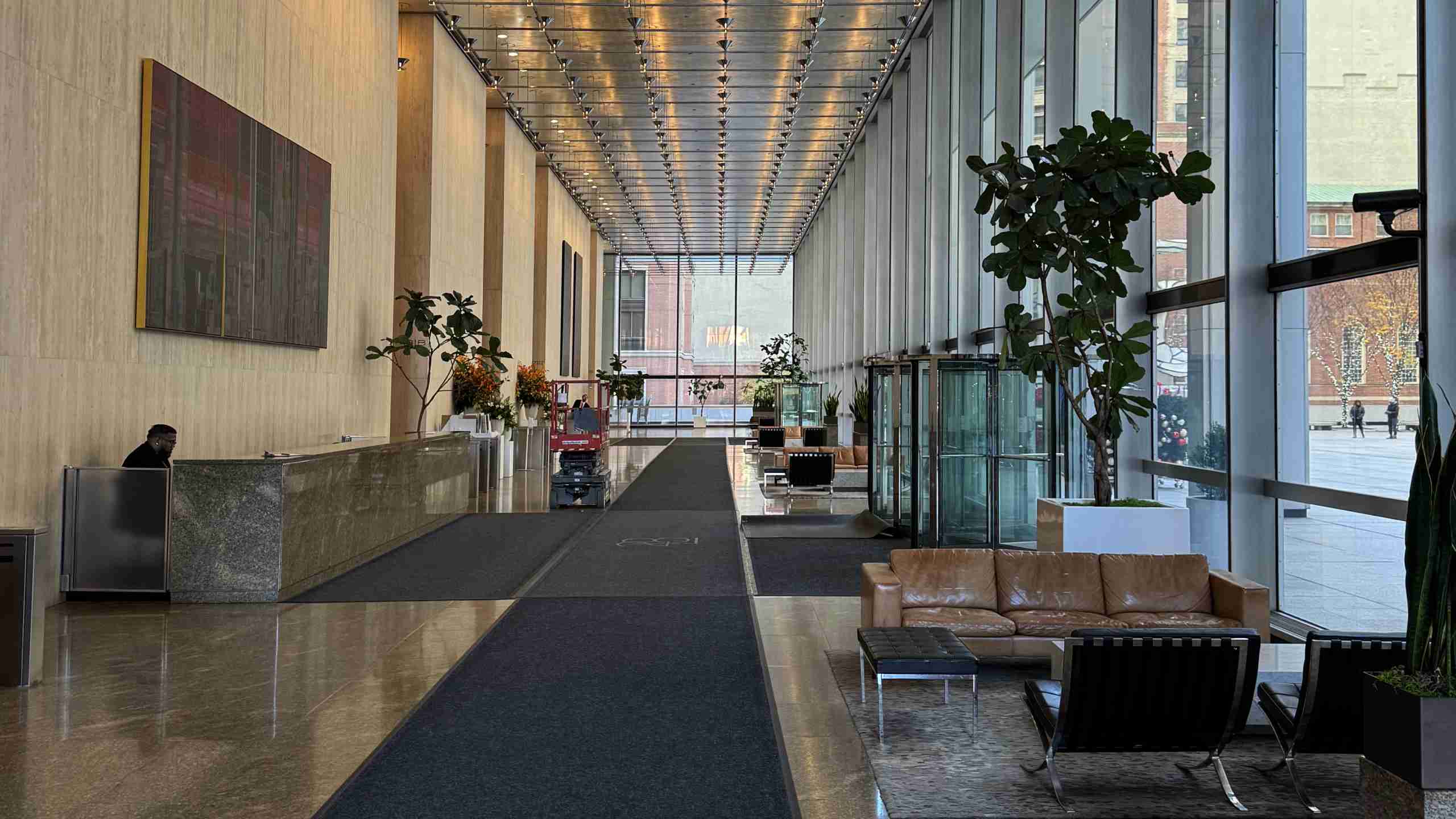
At David Rockefeller Plaza and the former Chase Manhattan Bank complex, we examine how postwar modernism transformed the Financial District. Open plazas, minimalist interiors, and integrated public space reflect new ideas about corporate identity, efficiency, and the relationship between architecture and the modern city.
33 Maiden Lane — Postmodernism and Architectural Expression
At 33 Maiden Lane, designed by Philip Johnson, we encounter a distinctive postmodern interior environment defined by geometry, color, reflection, and spatial layering. The building reveals the return of symbolism, theatricality, and architectural individuality in late 20th-century commercial design.
Fulton Center — Infrastructure as Civic Interior
At Fulton Center, contemporary infrastructure becomes an immersive architectural experience. Here, light, circulation, structure, and technology are orchestrated to shape movement and orientation within one of New York’s most complex transit environments.
Oculus — Contemporary Civic Space and Urban Spectacle
The tour concludes at the World Trade Center Transportation Hub, where structure, light, and movement combine in one of the city’s most expressive contemporary interiors. Designed as both transportation infrastructure and symbolic civic space, the Oculus reflects the evolving role of architecture in shaping collective urban experience in 21st-century New York.